Understanding POSCO Act

Child sexual abuse is sadly rampant in India. There are daily reports in the press of children, sometimes as young as six months, being raped or gang-raped and then being killed. For several years, the judicial processes were more aimed at adult victims, they were cumbersome and lengthy, and families and adolescents often did not report the abuse as the perpetrators, or their protectors threatened them with dire consequences. An added problem was that they feared the stigma and shame their child would be subjected to both through press and media inquisition as well as from the Neighbour’s and community. The third obstacle was the lack of separate child-friendly legal, medical and psychological support services to help children, and their families overcome their trauma and develop the confidence to face the police and the court.

In 2012, a landmark and separate Act, Protection of Children from Sexual Offences (POCSO) Act, was passed by the Government of India specifically to address the needs of child victims.  It encompassed an entire support system that included the police, health, justice and social sector so as to have a coordinated response to child sexual abuse, not just at the district level but down to the village level.  Further, it spelt out the punishment due to the perpetrators with higher levels of punishment to be meted out to those who are in fact in official positions or where they have a responsibility to protect the child.  They could be government officers or those who are in charge of homes, private and public, and who are tasked with the care of children.

Special courts have been set up to expedite cases of child sexual abuse. Some of the courts have introduced very sensitive measures to help the child when her or his case comes up for hearing. This includes creating child-friendly rooms that are colourful with a TV screen, books, toys and the child has a dedicated social worker.  The child enters the court through one entrance while the abuser has to use a different entrance to avoid any face-to-face contact with him or them.  Video links are set up for the hearing and this helps the child to be protected from conversing with too many people.

It must be stated that in the Act there are specific references to children with physical and mental disabilities particularly under sections that refer to incidents of aggravated sexual assault. The Act states that when a child with a physical or mental disability has been abused, the assistance of a special educator, or any person familiar with the manner of communication of the child, or an expert in that field having such qualifications and experience to record the statements of the child.

The Act also states the Central and State government officers are imparted periodic training on matters related to the implementation of the Act.

In principle, the Act has put systems in place to provide justice to all children, disabled or otherwise, in the event of an incident of assault or other forms of sexual abuse. However, there is little evidence of how children with disabilities are provided with information on how to protect themselves from abuse, how to even understand abuse, report any incidents and then be prepared for facing the legal processes.

Children have a range of disabilities- for instance, deafness.  There are others who have a combination of challenges and are unable to speak.  How are their needs and rights to have information fulfilled?  Are there a sufficient number of qualified and experienced trainers available around the country to meet their needs?  Communicating with these children requires the trainer to develop unique and innovative skills to create awareness amongst the children. Textbook teaching might not be the most appropriate technique especially for children with multiple disabilities. A range of tools – tactile and visual – needs to be developed that can also be aimed at parents and caregivers.

On a personal level, over the last 3 years, I ran two workshops for children and young people on child abuse leading up to sexual and reproductive health rights, one of which was on the outskirts of Pune city.  The two-day session with my students was a wonderful experience.  They were desperately keen to know about their bodies and about sexuality.  They were initially shy and I, therefore, started with the basics.   By the end of the training they asked questions ranging from how it was possible for a woman warden in a prison to rape women inmates, what is homosexuality, bisexuality, who is a transgender, what is surrogacy, why are girls blamed if a couple cannot have a child, in order words whose ‘fault is it?” what is a condom and on to other forms of pregnancy protection, trafficking of children, issues around personal space, where can they get help if they suspect they are being stalked and so on.  They knew very little about their own bodies, and nothing about the bodies of boys/men.

A challenge that I faced was that I could not find suitable teacher training materials in the market. Those that were available were made of plastic or wood, I felt was totally inappropriate.  I then hit upon the idea of making them myself.  I asked the lady in their canteen to part with some of the flour she had kneaded for making chapattis’.  This I used to make models of male and female organs. I even used a banana and a cucumber as samples for how the penis grows during a sexual act. I also dashed across the road and bought a few condoms so that they could feel them and know how it worked.  The children had no inhibitions whatsoever, and what should have been a half-hour question and answer session at the end of the workshop, extended to over 1.5 hours.

The youngest of the participants, was 14 then and had just taken her class 10 exams, sent me an email message the next morning to thank me profusely for sharing so much information with them.  She still keeps in touch with me.  Her disability has not come in the way of her learning, not just for an academic qualification, but also in reaching her goals of being a professional.  Here is an urgent need to create awareness amongst children with disabilities on ways and means of protecting themselves from sexual abuse, and what resources are available for them in the country from government agencies and non-government institutions and organizations. NGOs working with children with challenges need to train their children so that they understand their bodies, what parts of their bodies can be exploited and how to prevent exploitation. About not feeling guilty, but instead to be empowered and stand up for themselves.  We must help build their communication skills in talking about sexual abuse, knowing their rights to safety and protection, what the Act says the government can and will do for them, and their right to fight for justice.

Child Sexual Abuse (CSA) is a serious issue and can have a life-long impact on the child and can act as an impediment on the child’s future development.  Without strong support, victims or survivors might not be able to have a normal married life or relationships or even support their children who might experience similar abuse.

Author’s Bio

The author, Veena Lakhumalani has a career spanning 30 years with the British Council in India and 5 years with its office in Ukraine. From the late 1980s and early 1990s, she led their programmes in Health and Social Development. She initiated programmes for the British Council and the British Government on prevention of HIV and AIDS amongst Sex Workers in West Bengal, Disabilities, Violence Against Women, Child Protection and particularly child sexual abuse, Trafficking of women and children, Adolescent Reproductive and Sexual Health, amongst other social issues. She was invited by VAANI to guest write this blog to mark deaf awareness week starting September 23rd, 2020.

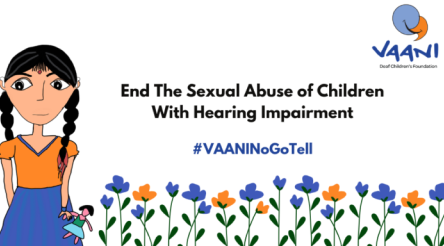
This DEAF AWARENESS WEEK, VAANI has launched an online sensitization campaign to increase public awareness on this topic of ‘Child Sexual Abuse Dangers To Hearing Impaired Children’, from. September 23rd, 2020.

If you are a parent, child, non-profit organization working in the field, corporate organization or community worker and would like to get involved, please write to <vaani@vaani.in>

#VAANINOGOTELL
My Journey With VAANI

My connection with VAANI began 14 years back when I had to accompany Ms.Brinda Crishna, the founder of VAANI, and Ms.Sreela Bose – one of the well-known experts in the field of deafness, for visiting some of the NGOs in Guwahati and Jorhat in Assam.

During one of these visits, what made me wonder was something Sreela di asked in one of her interactive sessions with the special educators of an NGO, “Do you know what can happen if one does not hear?”

No one answered. So she got all of us to plug our ears tight with our fingers. She spoke out a line and then asked us to unplug our ears and repeat what she said.

None of us could repeat the full sentence that she said, as we could not hear with our ears plugged.

She then said, “If you do not hear, you cannot repeat or speak; if you cannot speak you cannot communicate and the inability to communicate can lead to social and emotional imbalance, and delay in cognitive and language development.”

That was when I realized how blessed all the hearing people are, and ever since then my journey of curiosity to know and learn about ‘Deafness’ never ceased and I became a part of VAANI’s journey.

Close observation in the past was that a lot of people thought that supporting a hearing-impaired child meant providing Hearing Aids which was always willingly offered. There was very little understanding about the importance of all the rest that followed after being given a Hearing Aid to a deaf child – the auditory training and regular speech therapy which of course is not the only solution; as each child’s level of hearing loss differs and a Hearing Aid may not just be enough. So there is a need to also incorporate the use of signs, lip reading etc. and the other elements of nonverbal communication under such circumstances for effective communication.

VAANI’s work involves addressing all the aspects mentioned above – that follow after being identified – a holistic approach that includes empowering the parent or the caregiver along with the child’s intervention; covering the social and emotional needs of the child and the family in addition to bringing communication, comprehension and language into their lives to make it more meaningful and progressive.

The last 15 years of VAANI’s work with NGO partners and governmental agencies has brought about a shift in their thinking from just providing Hearing Aids to ensuring that the Hearing Aid is accompanied with an Ear Mould followed with arrangements for Speech Therapy Sessions.

While working with parents regularly a line often heard from them was, ‘Wish we met VAANI earlier’. This struck me and made me realize how VAANI’s touch began to make a difference in their lives and it kept me energized in this selfless journey.

The lacunae in data of Children With Hearing Impairment in the age group 0 to 3 years and the understanding of our partner agencies about the need for early intervention has led to VAANI’s pilot programme on New Born Hearing Screen at the Tumkur district in Karnataka. Plans for similar Programmes are in the pipeline for the states of West Bengal and Assam. VAANI is also playing the role of being part of the State Resource Group in Assam for the RMSA – Rashtriya Madhyamik Shiksha Mission (earlier also for SSA) to support with designing of the Screening Tool for field workers.

The Hearing Impaired Population is very scattered and those in difficult geographical terrain are often not reached. So this has always been a struggle to project a cost-effective programme which is looked into by funding partners.

Today, a Techno- friendly Team and the pandemic situation, has driven VAANI to reach out to this section – the unreached population with the help of Virtual Technology.

A lot is yet to be achieved and with the support of sensitized community volunteers, trained professionals, peers, corporates, parent champions, partner agencies, the government and a futuristic team VAANI hopes to reach greater heights ensuring that every deaf child has a voice and is part of the mainstream society.

Blog by Ms.Ajita Gohain

Deputy Programme Head

VAANI, Deaf Children’s Foundation

Weekend Volunteering At VAANI

This is the story of how I, a full-time corporate employee, transitioned from weekends filled with Netflix binge-watches to doing something constructive and productive with my time. It was June 2020 and by now work from home was the new normal as Covid19 had sadly enough made its way into every nook and corner of the world. We had zilch social life left and the monotony of routine was finally syncing in. To give you a little background of how I found my way to VAANI, there is something you should know about the firm I work at. We, at Morgan Stanley, celebrate June of every year as the “Giving Back” month where every employee of the firm tries to associate himself or herself with a volunteering activity.

It was while looking up for such activities in the “Giving Back” month when I came across an opportunity at VAANI. They needed volunteers to create learning material for the individualised educational classes that they conduct for the sound impaired kids. I figured this was a great way to spend a part of my weekend and I decided to contribute. This gave me an opportunity to give back to the community in a small way. Post this it occurred to me – we all have certain skills – some of us can draw, while others can write, some are fluent in spoken English while others can strike up a conversation with literally anyone, few of us are superb at technology while others have amazing organisation skills. Don’t we? And yet, we end up just spending our entire weekdays toiling at our workplaces and our entire weekends taking a break from all the toiling. But wouldn’t it just be food for the soul if we could use a very tiny fraction of our time and skills to do some good for the society?

Every child has a right to education and yet a few kids, especially the ones whose needs are a little different from what the society deems normal, seem to miss out on the fulfilment of that basic right. This is where VAANI, a Bengaluru based NGO, steps in. They advocate for the right of every deaf child to live a full and complete life with dignity and respect. Their mission to bring language and communication into the lives of deaf children and their families to enable these children to have meaningful conversations among themselves and with the world around them. This resonated deeply with me and I have decided to contribute my weekends in whichever way I can help VAANI reach a little closer to their goal.

I hope a few of you, if not all, who are reading this find it in you to take some time out of your busy schedule to join hands with this organisation that tries everything in their capacity to make sure every child knows how special he or she is and can grow up to be a light of the world – A light that this world is in dire need of, now, more than ever.

Blog By VAANI Volunteer, Ms.Namrata Singh

Considering the Social and Emotional Needs of Deaf Children and Families

Blog by Ms Brinda Crishna, Founder VAANI Deaf Children’s Foundation

The core of all the work we do at VAANI is the need to address issues of the total development of the deaf child, focusing on their social and emotional needs and those of their families, and the role of communication to address these issues.

Social and emotional needs of deaf children

When we think about a child, we have to think about the whole child. Emotional, cognitive, social and physical developments are interrelated and influence each other. However, in my over three decades of experience in working with children with disabilities, I have seen that most often, once a child is diagnosed with a disability, the whole child is often forgotten and the disability becomes the identity of the child, so a child is deaf, or has cerebral palsy or learning disabilities and so on. Rehabilitation programmes for deaf children focus on reading and writing and learning to speak and most often the development of the other facets of growth, especially emotional and social growth, get neglected.

All children need love, acceptance, appreciation, a sense of belonging and feeling of security to grow up as self-confident individuals. Control over their environment, becoming self-reliant and independent is important as a child grows. All children want to feel they belong in their environment, be this within their family, their school, and their neighbourhoods. The need to make friends and develop meaningful relationships, to share ideas, to contribute, basically to be able to communicate is an integral part of child’s life. Deaf children are no different and have the same needs.

In reality, however, the inability to hear leads to inadequate language development, gaps in comprehending the world around, and above all a sense of complete isolation for deaf children, as they are unable to express and communicate their needs. Hence there should be an urgency to address the issues of social and emotional well-being of deaf children, along with their need to learn to read and write. Therefore, the role of the family in supporting their children to understand and cope with deafness is of paramount importance.

Social and emotional needs of parents

The birth of a child is an occasion for joy and celebration. There is anticipated excitement. However, when parents learn that their child is not perfect, has a disability, the shock is unparalleled. Research has shown that the shock is often as great as having given birth to a stillborn child. In the Indian social structure, most often the mother is blamed for the disability and often leading her to be rejected. Hence there is a huge need to provide the parents with support to understand their emotional trauma and come to terms with it. It is only after they have begun to heal, from what often is thought of as a tragedy that they will be able to contribute and support the development of their own deaf child.

The VAANI model of Service Provision

At VAANI we consciously work towards understanding and providing support to this emotional and social need for parents and their deaf children. We believe that all work has to be done in partnership with parents and primary caregivers. The reason being that although the professional comes with technical knowledge and skills, it is the parents, especially the mother who knows her child best.

In order to develop this partnership where both groups make positive contributions and learn from each other, training is provided. Training is not only restricted to skill development so that the parents are able to work with their young deaf child with the challenges faced with hearing, communication and literacy. Programmes are also designed to instil in parents the ability and the confidence to accept their child’s “differences”, help and guide their child through her formative school years towards becoming a confident independent adult and groom themselves as agents of change by influencing policy-making authorities and the Government.

Training is provided to professionals, not only to develop their technical skills in working with deaf children but also to understand the social and emotional needs of families and their deaf children. These trainings include topics like understanding grief and trauma, how to listen to parents and provide basic counselling, developing parent support groups, how deaf children can communicate, express emotions and deal with difficult situations etc.

A change in one’s attitude, of being able to look at abilities, and not disabilities, to look at strengths and not weaknesses, appreciate difference as a unique facet of an individual is possibly the greatest lesson we can learn as professionals in the deaf sector.

Mandira and her Grandmother

In the length and breadth of our work, we sometimes come across children whose parents aren’t involved actively in their deaf child’s well-being and education. This happens for a multitude of reasons. It could be because of the loss of hope that comes with the fact that their child is disabled, the lack of time because their attention is with their other “normal” children, or even simply because they are too busy earning a living to feed the family. In such cases, it is common to see another member of the family taking responsibility for the child.

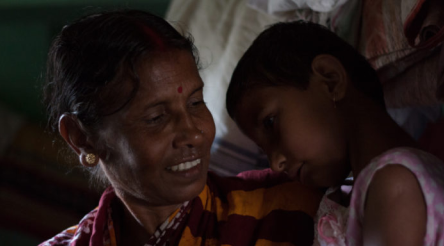
We visited the home of Mandira in Pandua, West Bengal. She is 11 years old and has been attending VAANI Sadhan Resource Centre for 5 years. We spoke with her maternal grandmother who has been Mandira’s primary caretaker, and within a few minutes of the conversation, it was very apparent how largely involved she was. Her grandmother had suspected that something could be wrong with Mandira when she was only 5 months old. She noticed that Mandira wouldn’t react to loud noises when she was asleep. She discussed her fears with the rest of the family, but they were not inclined to accept what she said. When Mandira was 9 months old she had a bout of bronchitis and was taken to a child specialist by her grandmother.

Despite insisting to the doctor that Mandira was not responding to sounds, he ignored it and treated bronchitis only. A few months later she took Mandira to the doctor again and he then said there could be something wrong and referred her to a testing centre. The doctors asked if the mother had been ill sick during the pregnancy. She was; she had German measles.

The grandmother then took charge of things to ensure the child’s well being. She laboured through a long-drawn-out process of acquiring a hearing-aid for Mandira, which involved getting attestations from local MPs, MLAs, and even the Block Development Officer. She fought through the red tape until she acquired the heading-aid. Mandira was put into a school and was being taught to speak, but because of the lack of proper training on how to teach the deaf, she didn’t learn enough. Just acquiring a hearing-aid wasn’t enough.

Her grandmother eventually heard about the Sadhan Resource Centre and the work that is done there. They have both been visiting the centre for 5 years now and they already see a lot of change in Mandira. She is still shy but her grandmother is certain that if she continues to learn at the Sadhan Resource Centre, she will soon become more confident.

The grandmother sees herself as an advocate for the rights of her deaf granddaughter. She will stop at nothing to ensure that Mandira gets the best attention, training and support she deserves. Other parents who come to the Sadhan Resource Centre find it comforting and encouraging to talk to the grandmother – she is seen as wise and empathetic and has plenty of practical, hands-on advice.