Limitless Horizons: Building Stronger Pathways for Deaf Children and Families

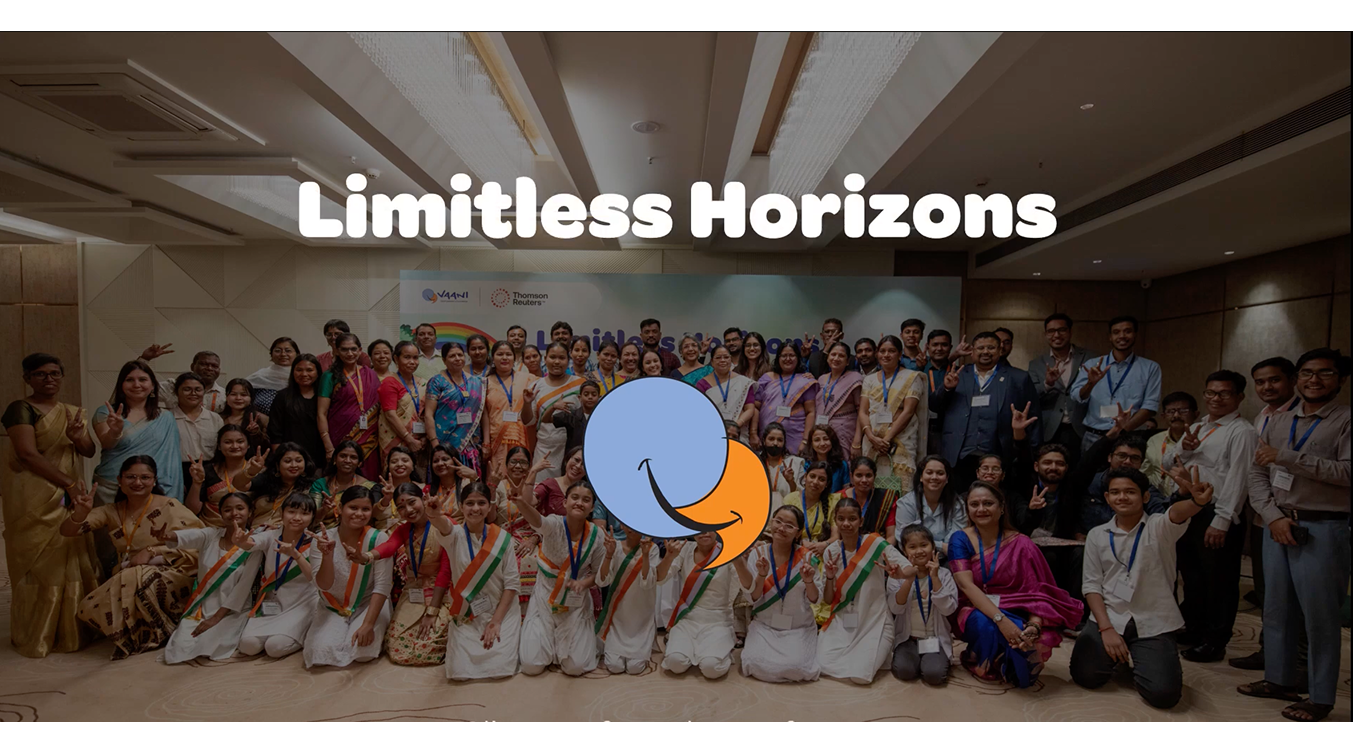
On 21 February 2026, VAANI Deaf Children’s Foundation hosted the National Conference “Limitless Horizons” at Novotel, Guwahati, bringing together parents, educators, health professionals, government representatives, development partners, and advocates committed to creating a more inclusive future for Deaf and Hard of Hearing children and youth.

Supported by Thomson Reuters, the conference served as a powerful platform for dialogue, learning, and collaboration. It reinforced a shared belief that when families, communities, institutions, and systems work together, every deaf child can thrive and achieve their full potential.

A Gathering of Voices That Matter

The conference witnessed participation from senior representatives of the Departments of Health and Education, professionals working in disability inclusion, experts in early intervention and inclusive education, corporate leaders, parents, and Deaf youth. Their collective experiences and insights enriched the conversations and highlighted both the challenges and opportunities that exist in building inclusive ecosystems.

Throughout the day, discussions focused on strengthening support systems across the life cycle of a deaf child—from early identification and intervention to education, higher education, and employment.

Early Identification: The Foundation for Better Outcomes

Mr Nitin Sisodia from SOHUM Innovation Lab highlighted the critical importance of early hearing screening and intervention. He shared how low-cost newborn hearing screening technology can help identify hearing loss at an early stage, enabling timely support and significantly improving developmental outcomes.

His session emphasised the importance of strengthening referral pathways and empowering parents to become active participants in their child’s early intervention journey.

Responsive Parenting and Inclusive Education

Dr Varsha Gathoo introduced participants to the concept of the “3Rs” of responsive parenting, while advocating for child-centred learning approaches and Universal Design for Learning (UDL). Drawing from the principles of the National Education Policy (NEP) 2020, she highlighted how inclusive educational environments can support diverse learners and create meaningful learning experiences for Deaf children.

Her session reinforced the idea that parents and educators play an equally important role in helping children develop confidence, communication, and a love for learning.

Parents as Changemakers

Ms Brinda Crishna and Ms. Inky Sen highlighted how parental support and community awareness can transform deaf children’s educational and career journeys and provide them with social and emotional support.

Most importantly, they demonstrated how parents can become powerful advocates for their children and for the wider Deaf community.

Their experiences resonated deeply with participants and served as a reminder that empowered parents are often the strongest drivers of change.

Expanding Horizons for Deaf Youth

As children grow, the need for pathways beyond school becomes increasingly important. Addressing this critical transition, Mr Aman Sharma explored opportunities in higher education, skills development, and employment for Deaf youth.

His session challenged traditional perceptions about disability and employment while showcasing examples of Deaf individuals succeeding across professional sectors. The discussion encouraged stakeholders to think beyond basic inclusion and focus on creating meaningful opportunities for long-term independence and career growth.

The Role of Corporate India

Representing Thomson Reuters, Ms Ashika G spoke about the importance of purposeful corporate engagement in the disability sector. She highlighted the need for stronger investments in the Northeast and encouraged partnerships that move beyond compliance-based CSR approaches toward sustainable, community-led impact.

Her address underscored how collaboration between civil society, government, and the corporate sector can accelerate inclusion and create systemic change.

Celebrating Confidence, Talent, and Inclusion

A special highlight of the event was a cultural performance by Deaf children. Through dance, expression, and visual storytelling, the children showcased their talents, confidence, and creativity, receiving enthusiastic appreciation from the audience.

The performance served as a powerful reminder that disability does not limit potential; rather, it is access and opportunity that make the difference.

Looking Ahead

As the conference concluded, one message stood out clearly: inclusion is not the responsibility of one stakeholder alone—it is a collective effort.

“Limitless Horizons” reaffirmed the importance of early identification, family empowerment, inclusive education, youth development, and cross-sector collaboration. It strengthened the commitment of all participants to continue building systems where Deaf and Hard of Hearing children can learn, communicate, participate, and succeed with dignity.

At VAANI, we remain committed to creating these pathways and ensuring that every Deaf child is given the opportunity to dream, achieve, and lead a fulfilling life.

Because when families, communities, institutions, and systems come together, there truly are no limits to what a child can achieve.
VAANI Receives Indian CSR & Sustainability Award 2026 for Most Impactful Rural Healthcare Initiative

We are delighted to share a proud milestone in VAANI Deaf Children’s Foundation’s journey. Along with our CSR partner Thomson Reuters, VAANI has been honoured with the Indian CSR & Sustainability Award 2026 under the category of “Most Impactful Rural Healthcare Initiative.”

This recognition is deeply meaningful for us as it reflects the collective efforts of our children, families, hospital partners, donors, volunteers, and the entire VAANI team who continue to work tirelessly towards creating inclusive opportunities for Deaf and Hard of Hearing children across India.

Over the years, VAANI has worked extensively in the areas of newborn hearing screening, early identification, educational intervention, parent support, and community awareness. Through our partnerships with government hospitals and grassroots communities, we have been able to reach thousands of newborns and families, particularly in underserved and rural regions where access to hearing healthcare and intervention services remains limited.

This award is not just a recognition of a programme, it is a recognition of every parent who chose hope, every child who overcame barriers, every healthcare worker who supported early screening, and every supporter who believed in our mission.

We would especially like to thank Thomson Reuters for their continued partnership, trust, and encouragement. Their support has helped strengthen our efforts towards early identification and intervention for children with hearing impairment, enabling us to create a meaningful impact at the grassroots level.

Making Ear Health Information Accessible: VAANI’s IEC Materials in Government Hospitals

Sometimes, small habits make a big difference. Simple practices like keeping ears clean safely, avoiding inserting objects into the ear, and paying attention to signs such as delayed response to sound can prevent long-term challenges for children. Awareness around ear health is not complicated—but it needs to be consistent, accessible, and easy for families to understand.

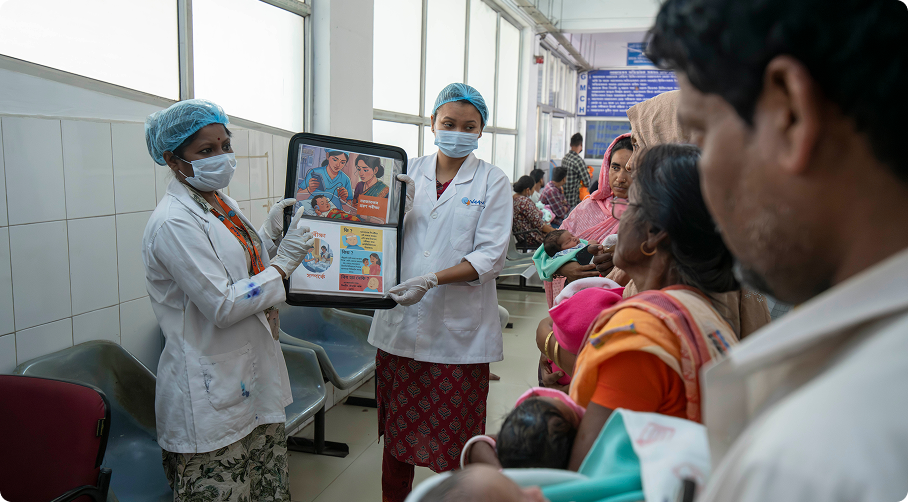
At VAANI Deaf Children’s Foundation, we work closely with families and communities to ensure that essential information about hearing and early childhood development reaches people in clear and practical ways. As part of our Newborn Hearing Screening Program in government hospitals, VAANI has developed Information, Communication, and Education (ICE) materials that are displayed within hospital spaces where new parents and caregivers visit.

These materials are designed to be simple, visual, and informative, helping parents understand basic ear care practices as well as the importance of early hearing detection. One key feature of the materials is a guide to hearing milestones for children from birth up to 24 months of age. This helps parents recognise how babies typically respond to sounds as they grow—from startling at loud noises to turning toward voices and beginning to imitate words. When parents know what to look for, they are better equipped to identify early signs of hearing concerns and seek support quickly.

To make information even more accessible, the posters include a QR code that visitors in the hospital can scan using their phones. This allows parents and caregivers to instantly access additional guidance and resources, making reliable information available whenever they need it.

Another important aspect of this initiative is language accessibility. Recognising that families come from diverse linguistic backgrounds, VAANI has translated these materials into several local languages—Marathi, Kannada, Assamese, Khasi, and Bengali. By presenting information in languages that families are most comfortable with, we ensure that the message is not only seen but truly understood.

Through these ICE materials, hospitals become more than just places for medical care—they become spaces of learning and awareness for families. When parents are equipped with the right knowledge early, they can take timely action, seek screening and intervention if needed, and support their child’s development with confidence.

Because when it comes to hearing health, early awareness can make a lifelong difference.

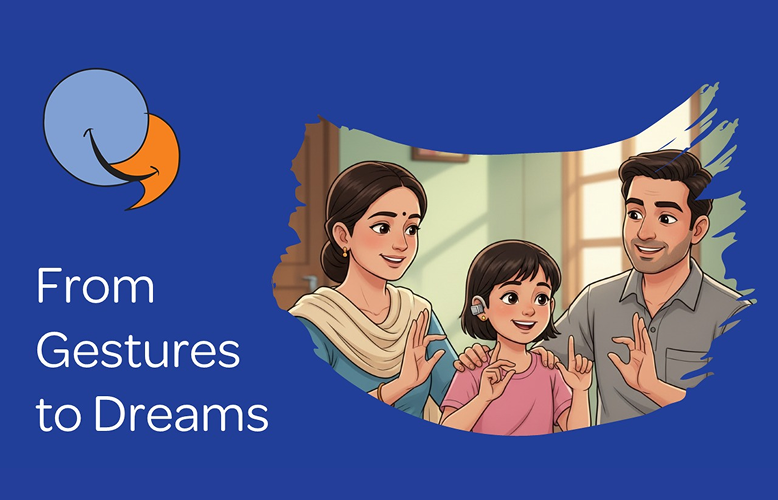
From Gestures to Dreams: The Transformative Power of Communication

A mother’s hand, a father’s strength: Gitartha’s story

When Binapani first watched her little boy scribble answers that did not match the strange, incomplete sounds he made, she felt a knot of worry tighten in her chest. Gitartha was three, and where other children in Khutikotia played with words, he held them back. A diagnosis in Guwahati and later in Chennai named what the family already feared: bilateral severe to profound hearing loss.

His father, Benudhar, stood steady through the long commutes, hospital visits, and decisions about schooling. Though worried, he worked quietly in the background to hold the family together, while his wife sought new ways to reach their son.

At VAANI, both mother and son began learning Indian Sign Language. Together they discovered that what had looked like silence was, in truth, a crowd of unmet meanings waiting for the right doorway.

“At VAANI, both Gitartha and I learned to use sign language, and that brought clarity to what he wrote and thought. I never realized how deeply hearing loss could impact speech and learning. VAANI became our guide — teaching me everything from the nature of deafness to how to truly support my son,” says Binapani.

In April 2025, Gitartha passed his Class X board exams with First Division. He now studies Class XI, loves javelin and art, and dreams of computers. For his father and mother alike, that result is more than marks: it is the confirmation that a child’s mind is never less than whole; it only needs the right keys to open.

When gestures turned to dreams: Arjuara’s journey

In Goroimari, 21-year-old Arjuara grew up relying on gestures and lip-reading after rejecting her hearing aids. Her father, Islam Uddin, and her mother, Lalvanu Nessa, tried every avenue available — moving her between schools, standing by her when progress seemed uncertain.

Their persistence was rewarded when a VAANI camp introduced them to a new path. Registered at the Outreach Centre in 2020, the family found patient teachers who showed them that education could be accessible.

“The teachers continuously helped by explaining and simplifying complex concepts, which benefitted Arjuara immensely. I am deeply thankful for all the support she has received,” her mother recalls.

That support carried Arjuara to a First Division in her Class X exams in 2025. Today she studies science and dreams of joining the medical field — a dream her father supports with quiet determination.

A family’s leap of faith: Abhijit’s move to Guwahati

For Abhijit Das, now 17, the turning point came when his parents made a difficult decision: to leave their home in Dudnoi and move to Guwahati so he could have access to a school and resources. His father, Dhiren, shouldered the responsibility of relocating the family, while his mother, Rita, sought the skills to communicate with her son.

“I did not know how to communicate properly with my son. VAANI helped us learn how to understand each other. That connection allowed me to support him in his early learning, and gradually, he developed an interest in studying. Today, seeing him pass his 10th exams feels like a dream come true,” Rita shares.

Abhijit now studies in Class XI and dreams of a career in technology. His father’s sacrifice and his mother’s persistence remind us that progress is always built on shared strength.

The quiet strength of fathers, the fierce advocacy by mothers

Across Kolkata and Assam, mothers often became the visible anchors — attending workshops, sitting through remedial classes, interpreting for teachers. But the fathers’ roles were no less vital. They worked long hours, often in modest jobs, creating stability so that their children could attend schools or travel to VAANI centres.

Shuvam’s father, Lalon Rajwar, earns about ₹7,000 a month as a garage mechanic. His wife, Purnima, recalls: “The progress of our son has been remarkable. Whatever he has learned — especially in maths — is because of the support from VAANI. I’m deeply thankful to the teachers and the entire team. VAANI didn’t just help my child; it helped me grow into a better, stronger parent.” Lalon’s steady income, though small, sustained the family’s hope while his wife carried their son’s educational journey.

For Imran, his father Abdul Quddus and mother Naznee felt helpless at first, but later expressed their gratitude together: “We are overjoyed that our son has passed his 10th Board exams. We are immensely thankful to VAANI and the entire team for their unwavering support.”

In family after family — from Rejoyan’s parents in Basirhat to Muskan’s father Khalil in Kolkata — the picture is the same: mothers stepping into the role of teachers, interpreters and motivators, and fathers providing the backbone of stability, sometimes unseen, but always crucial.

Communication as dignity

These voices tell us something clear: when sign language is respected, taught, and resourced, children learn, parents connect, and families stay whole. When it is denied, children are left behind, even when their minds and hearts are brimming with possibility.

As Muskan’s mother puts it: “In the beginning, Muskan knew only a few words. But with time, guidance, and regular home practice, I could see her change and grow. I always stayed in touch with VAANI’s teachers whenever I had doubts.”

And from Isha’s teacher Soma, the transformation is visible: “She used to be afraid of math, but we gave her specific strategies and cue words. With time, she began improving steadily.”

Beyond silence, toward rights

Communication is not just about words. It is about being seen, understood, and loved. For these families, Indian Sign Language turned silence into connection, and connection into success.

These stories remind us that sign language rights are not abstract. They are the right to childhood, the right to learning, and the right to dream.

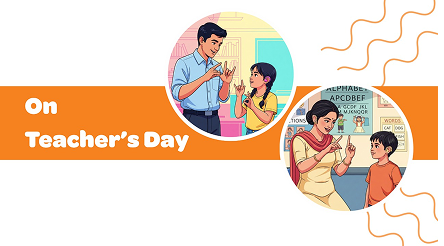
Teachers of the Deaf: The Bridge That Connects Hearts and Voices

On Teacher’s Day, we often think of classrooms, blackboards, and lessons. But for children who are deaf or hard of hearing, teachers play an even more profound role. Teachers of the Deaf (ToDs) are not only educators; they are bridges—linking parents and children, communication and understanding, silence and expression.

A Bridge Between Parents and Children

“Working with deaf children means being part of a meaningful journey where every small achievement brings a big smile. It’s about giving voice to silence, building trust, and creating opportunities for children to express themselves and grow with confidence.”
— Jayanta Gogoi, Teacher of the Deaf

For many parents, discovering that their child is deaf can be overwhelming. Questions about communication, schooling, and the future can feel heavy. Teachers of the Deaf step in at this very point of uncertainty. They show parents that deafness does not mean the end of dreams. With patience and compassion, they guide families in learning how to connect with their child through sign language, gestures, or speech. In doing so, they bring light back into homes that once felt clouded with doubt.

What Teachers of the Deaf (TODs) Do

Every day, ToDs do the quiet, essential work of making communication possible. They help children learn their first signs or spoken words, build confidence in self-expression, and slowly bridge the gap between home and school.

For Meghana, who has been with VAANI for over four years, each step forward feels miraculous:
“Every word these children speak feels like a wonderful gift. The parents and the community respect us with great pride, and that makes me very happy.”

Their work extends beyond language. They support life skills, emotional development, and vocational training. They prepare children not just for exams, but for life itself. They also walk alongside mainstream teachers, offering ways to adapt lessons so that deaf children are not left behind.

Changing Lives — Including Their Own

The relationship is not one-sided. Teachers of the Deaf often speak about how deeply they are changed by the children they teach.

“The best part of my job is witnessing the progress and growth of deaf children—whether it’s watching them learn new signs, develop language skills, or build confidence in communication. These moments are truly rewarding.”
— Dipti Acharjee, Teacher of the Deaf

For Laxmi, the work came at a turning point in her own life. After an accident left her with a disability, she found a new purpose through VAANI:
“VAANI allowed me to work with deaf children—such loving children with strong bonds with parents. All parents show respect and gratitude. Every smile makes me thankful for this chance.”

In these reflections, you hear both sides of the bridge—the joy of children learning, and the fulfilment teachers feel in guiding them.

Honouring Them This Teacher’s Day

Teachers of the Deaf are not always in the spotlight. Yet their patience, creativity, and determination ripple through the lives of children and families for years to come. They are the steady hands that guide a child’s first sign, the reassuring voice for parents, and the advocates for inclusion in schools and communities.

🧡 This Teacher’s Day, we honour every Teacher of the Deaf who walks beside families and children, proving that education is not only about sound—it is about connection, confidence, and love.

A Story of Silent Strength and Unheard Dreams

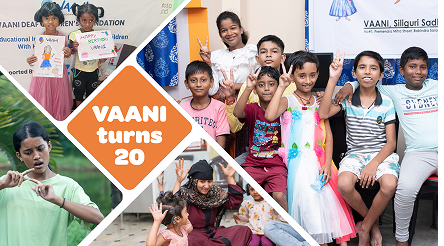
VAANI Turns Twenty

Imagine a father, wanting desperately to understand his child, but unable to get through to her.
Someone who starts to believe, after a point in time, that his daughter is locked in her own world—unreachable.
And then, imagine his face—how it lights up on the day they both learn to communicate for the first time. With gestures, broken words, and some sign language.
For the father, it is truly the first time meeting his daughter.
For the daughter, it is the first time she is seen.

This is the kind of magic VAANI has been creating for twenty years.

The Beginning of a Quiet Revolution

Two decades ago, in 2005, in the bustling city of Kolkata, a quiet revolution began. In a small room tucked under a staircase, a group of determined mothers came together.


They didn’t have grand resources—just a shared longing to connect with their deaf children.

With guidance from a visionary leader, Ms. Brinda Crishna, a veteran in the disability and development sector, VAANI Deaf Children’s Foundation was born.

“As VAANI steps into its 20th year, I took a moment to look back on the road we have travelled, and then to look forward to see how far we have come.

Remembering where we started from, I marvel at how much we have achieved together.

I am humbled by the contribution and commitment of every single member of VAANI, who added their unique individual strengths to our team.

I rejoice with the children and families of VAANI, at their successes and will be forever grateful to them for having given me a purpose that has filled my life, and made me a more caring human being.

In the final analysis, the success of VAANI can be measured in the many lives which have been changed for the better, and from the continuing efforts to widen the outreach to touch every hearing impaired child and their families.”

Brinda Crishna, Founder

From the very beginning, VAANI was powered by one powerful idea:

Every deaf child deserves to live with dignity, joy, and the ability to communicate with their world.

The Early Years (2006–2018): Planting the Seed

Imagine a mother who used to think her son was just being disobedient—throwing tantrums, refusing to follow instructions.
She thought he was being naughty.
Until she sat through a session at VAANI and realised he wasn’t being difficult—he was begging to be understood.

During these foundational years, VAANI focused on:

  • Educational interventions
  • Parent empowerment

Through direct education programs for deaf children aged 0–14 years, the foundation brought language, learning, and belonging into the lives of hundreds of families.

These weren’t just classes—they were lifelines.

Turning a New Page: Innovation and Expansion

In 2019, VAANI launched the Newborn Hearing Screening Program, in partnership with public hospitals and government agencies.

For the first time, deafness could be identified at birth—allowing for early intervention and better life outcomes.

In 2020, as the world reeled from the COVID-19 pandemic, VAANI adapted.
Instead of retreating, the team innovated:

  • Blended learning methods
  • Digital content
  • STEM education for deaf adolescents

The goal: to build resilience, curiosity, and future-readiness in children often excluded from such opportunities.

Celebrating two decades of unwavering dedication, VAANI Deaf Children’s Foundation—established in 2005—has consistently stayed true to its mission of empowering Deaf children and families through communication , dignity, and opportunity. A heartfelt salute to our passionate team, courageous children and families, and steadfast patrons—your trust, resilience, and commitment have shaped our journey.

Marissa Dunne, Head of Programmes

In 2022, VAANI launched the Youth Transition Program, expanding its work into vocational training—digital literacy, tailoring, and self-defence—equipping deaf youth for independent livelihoods.

Imagine a deaf teenager in a small town, once told she’d never be able to work.
Now imagine her stitching school uniforms or teaching self-defence to younger girls—her hands speaking volumes.

The Dream Ahead: 2025 and Beyond

Now, as VAANI turns 20, a new dream is taking shape.

Groundwork is underway for India’s first Higher Education Academy for Deaf Students in West Bengal.

This six-year post-10th curriculum will blend:

  • Academics
  • English language training
  • Life skills and vocational pathways

This isn’t just a milestone. It’s a movement.

“As VAANI completes 20 years, I look back with deep humility and immense pride. We began with a small group of mothers, meeting in tiny rooms or under staircases—wherever we could find space to connect with our deaf children. Those same mothers, who once wept with uncertainty, are now our proud parent leaders, inspiring and mentoring others.

Our passionate teachers, who stood by us through thick and thin, are today leading programs and training the next generation of educators. Our deaf children—once struggling to be understood—are now completing higher education and shaping their own successful futures.

What started as a focus on education has now expanded into newborn hearing screening, vocational skill-building, and holistic support across the life cycle of a deaf child. We’ve seen it all, and today, we stand truly humbled.

What began as a small voice for the deaf has grown into a powerful movement for inclusion, empowerment, and rights. This 20-year milestone is not just a celebration of our journey—it’s a call to action for the future. Together, let us ensure that every deaf child in India is heard, seen, and given the opportunity to thrive.”

— Sumedha Joglekar, Executive Director

This is where a deaf student who once struggled to write their name will one day sign their college diploma.

Why It Matters

Most deaf children in India are born into hearing families—families who, through no fault of their own, don’t know how to connect.

The result?

A lifetime of miscommunication, frustration, and unspoken pain.
A child is labelled “slow” or “disobedient”—when they are, in fact, intelligent, observant, and deeply emotional.
A parent feeling unloved, when the child simply doesn’t have the words to say “I love you.”

This communication gap doesn’t just hurt relationships.
It limits dreams, shuts doors, and chips away at confidence—until the child stops trying to be heard.

VAANI’s mission is to close that gap—one conversation, one connection, one child at a time.

What We’ve Built Together

  • 20,000+ deaf children reached
  • 40,000+ parents trained and empowered
  • 11,000+ teachers and professionals sensitised
  • 40,000+ community members educated

Behind each number is a story:

The father who finally understood his daughter’s dream to dance.
The young man who found his calling in coding.
The girl who now wants to become a teacher.
The mother who learned to stop blaming her child—and started cheering for him.

The Heart of VAANI

At its core, VAANI is not just an organisation—it’s a family.
A family that believes in the right of every deaf child to live a full life—with communication, respect, love, and opportunity.

This journey of twenty years is a tapestry of:

  • Struggle
  • Perseverance
  • Learning
  • Joy

And yet, this is only the beginning.

With our dedicated team, resilient families, and unwavering supporters, we look forward—with hope and fire in our hearts.

Here’s to the next chapter.

Here’s to a world where no deaf child ever feels left behind.

Bringing Stories to Life Through Puppetry!

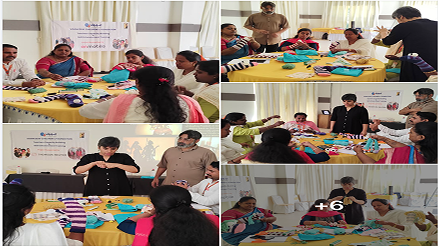
At VAANI Deaf Children’s Foundation, we are always exploring creative ways to make learning more visual, interactive, and joyful for our children. On 25th February 2025, our educators participated in a vibrant puppetry training session led by the incredibly talented Ms Sangya and Mr Hashim from #ThePuppetarians—and what a magical day it was!

This engaging workshop wasn’t just about play—it was a deep dive into the art and power of storytelling through puppets. Our teachers learned to craft puppets using simple, everyday materials and bring them to life with character development and expressive movements. The hands-on nature of the session allowed every participant to explore their creative side while thinking about how these tools can enhance the classroom experience for deaf children.

A major highlight of the day was the shadow puppetry segment—where light, silhouettes, and imagination danced together to narrate stories in the most enchanting way. For our educators, it was a reminder of how visual mediums can break barriers and spark learning in ways that words sometimes can’t.

This workshop showed us how puppetry can be a powerful educational tool—encouraging expression, stimulating imagination, and creating meaningful connections for our children.

Their support made this learning opportunity possible and will have a lasting impact on how we deliver inclusive education.

Here’s to more storytelling, more smiles, and more moments of magic in the classroom!

Building A Community Leader

If you have been following our blog or heard us talk about our work, you might know that the pinnacle of our work is reached when parents of our deaf children take the initiative to be leaders in their own communities.  We have one such story to share with you.

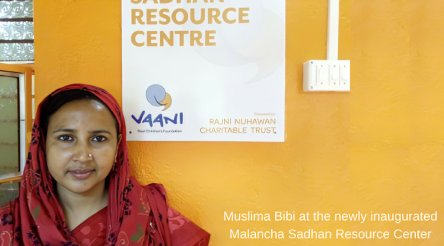
Muslima Bibi is a young mother of three. She lives in a little village near Malancha, 56km from Kolkata. Four years after she had her second son she discovered that he was deaf. She spent the next four years going from one facility to another across the state but was unable to find the right kind of help. The pain of not being able to communicate with her child was growing. She eventually heard about Vaani and decided to pay us a visit. Just around that time she had her second son who she later found out was deaf too. She has been bringing both her deaf sons to the Vaani Sadhan Resource Centre in Kolkata diligently despite having to travel 3 hours one way for each trip.

Once the news about finding the right kind of services for her children spread across her village, other parents of deaf children began to approach her for details. But for most of them, the 3-hour travel was too much. Muslima began to see the need for such services in her village and decided to take the initiative. Little over a year ago, she approached Vaani to start services in Malancha. She offered up her cowshed as space and identified 4 other deaf children who would attend. Vaani started sending her 1 Teacher of the Deaf for 1 day of the week. And just 11 months later, she had 22 deaf kids enrolled!

For months she made it work under the cowshed. But it really was just a cowshed. It was unsecured and had no doors that could be locked.  After each day’s lesson, Muslima would lock all the teaching and learning materials in a box and keep it away in her house. She would also unhook the fan and light so that it would not be stolen. During the rains, the roof would leak and damage the toys and materials. Muslima and the other parents expressed their wishes to have a pucca structure and expanding it to accommodate the growing numbers. They also wanted to make their Link Centre a self-reliant one.

We took Muslima’s story of courage and initiative to prospective donors. Soon enough, the Rajni Nijhawan Charitable Trust picked up on it. They were so moved by the story that they decided to fund the entire renovation of the cowshed and a second room to accommodate the growing numbers.

This two-year long journey has been one of the most gratifying and reassuring experiences. It proves to us that if we persevere, our beneficiaries will take our work forward themselves. It is always lovely to see parents take the initiative to give back to their communities. It nurtures a sense of camaraderie and lets every parent know that they aren’t alone in their struggles. We’re hopeful of what the future holds for the deaf children of Malancha. Without the generous support of the Rajni Nijhawan Charitable Trust, Muslima’s dream would not have materialised.

The Parents Perspective- Talking to Children About Preventing Sexual Abuse

Bashita sounded polite and gentle over the phone. For such a strong woman, she was also jovial and quick to laugh. Bashita raises her three sons largely by herself while her husband often travels for work and isn’t able to stay with them. While he plays the traditional role of the patriarch- supporting the family and inculcating values of honour and respect, Bashita is responsible for the everyday care and the upbringing of the children.

The most inspiring thing about Bashita though is her openness. When asked about her children, she brims with pride. As a mother of three young gentlemen, she has seen and heard it all. Her youngest boy Niljoy, now in the 10th standard is deaf and is the shyest of the three.

Even for a mother like Bashita, talking about sex, puberty and reproduction is still an unspoken taboo. How did her sons learn about puberty and sex? The same way that most children learn- through television, mobile phones and in conversations with their friends.

This can be problematic as the portrayal of sex on television is far from accurate, often dramatized and sometimes violent. It is not intended for educational purposes.

Similarly, children in peer groups do not have full information and the lack of open and clear discussions with an adult can lead to many misunderstandings. She is also concerned about her youngest son Niljoy. As a shy child with few friends, he doesn’t have the same kind of exposure that her other two sons received in their teenage years. He is embarrassed to talk about his body and turns away when these kinds of conversations arise.

In the war against child sexual abuse, information is our greatest weapon, but a heavy one that we must choose to weild. Talking to our children about their bodies is critical. Deaf children especially can be 2-3 times more prone to abuse and have difficulties communicating with adults about what has happened.

We can change that.

Helping young children identify parts of the body without shame or guilt is the first step. Teaching our children the NO, GO, TELL rules and about safe and unsafe touch will go a long way in helping the child express themselves and escape from potentially threatening situations.

Bashita agrees that as a mother, she had never thought about talking to her boys about her own menstrual cycle. Living in the same home, they were aware that on some days in a month she did not light the fire in the pooja room. On these days she is sometimes more tired and takes a break from the cooking as well. She thinks that her elder son may have learnt about menstruation at school in the 8th standard as it was a part of the syllabus in their biology classes and talked to her younger sons about it. But she is unsure how much detail the teacher went into and the textbook mostly covered a diagram identifying the internal parts of the body.

No one in her family ever spoke to Bashita and so it never occurred to her that a conversation with her son was required. They would learn the same way she did, slowly and over time through friends and general exposure.

“If I am equipped with some training, I will feel more confident to have such discussions with my children. I should be able to answer their questions and help them find more information if they need it.” Bashita says.

VAANI’s #VAANINOGOTELL campaign aims to break the silence around child sexual abuse and empower families with the information they need to educate their children. Get involved by following us on social media and helping to spread the message.

*Names have been changed to protect the privacy of the individuals and their families.


Fighting The Abuse of Children With Hearing Impairment #VAANINoGoTell

The Human mind is very complex.

The thinking power and intelligence of the human species have allowed us to harness nature for all our needs. We have even managed to reach beyond the Earth and moon reaching into distant galaxies, but here at home, there are still many examples of criminal acts arising out of deadly sins such as anger, greed, lust and so on.

Sexual assault, especially against a child, is a crime, which exposes the lowest level of perversity down to which a criminal mind can plunge. The innocence of childhood, and even teenage, makes them an easy victim of a cowardly criminal mind.

Child sexual abuse (CSA) is a serious and widespread problem in India, as it is in many parts of the world today. Statistics show that in India, every 155 minutes, a child under 16 years of age is sexually exploited. Ref:(PDF) Child Sexual Abuse in India: Current Issues and Research. Surveys show that 90% of people who sexually exploit children are people whom the children know or trust, such as family members, relatives, or neighbours. Sexual assault can also maim the child permanently.

Sexual exploitation is not rape alone. There are many forms of abuse such as: clicking indecent photographs of children, making children watch pornographic content, physically teasing them, etc. The trauma associated with sexual abuse can contribute to arrested development, as well as a host of other psychological and emotional disorders – children can become guilty, fearful, lonely and worried.

In the case of hearing-impaired children, both boys and girls- their inability to communicate or call for help, increases the risk of sexual molestation.  Hearing-impaired children and teens lack close communication with social groups and even within the family, especially if family members are not used to sign language.

Vicious minds find deaf children and teens a soft target to catch by pretending to care and love. Bullying methods may also be used, knowing full well that the child will not be able to report the act and name the perpetrator in a coherent, effective manner. Witnessing the harrowing ordeal of a 12-year-old child dealing with an unwanted pregnancy was the very impetus which resulted in the founding of VAANI by Ms.Brinda Crishna.

Communication barriers make it difficult to teach deaf children ideas such as personal safety and healthy touch. They lack skills of socialization and have decreased opportunities for incidental learning by observing the social behaviour of others. There is also a paucity of useful educational resources such as safety curricula and sexual abuse/kidnapping prevention programs.

Considering that the danger may be lurking close by, it is necessary to teach children right from early childhood about  “Good Touch” vs “Bad Touch”, knowledge of body parts, body privacy of self and others, the role of parents, nurses, doctors as regards a child’s body, saying “NO” to adults who violate these rules, and the need to tell parents if anyone behaves inappropriately.

Prevention is always better than aftercare.

The communication barriers in teaching deaf children need to be tackled by both parents in this case. VAANI, through its #VAANINOGOTELL campaign endeavours, to help parents and teachers first overcome their own inhibitions in addressing this issue.  It is important to use correct anatomical terms in explaining body parts and right or wrong actions.  Teachers and parents learn to use visual aids, they are coached to establish an open dialogue with the child and to teach by discussing everyday happenings with children. This gives them the confidence to approach parents or caregivers, without feeling guilty or confused.

Vicious minds find deaf children and teens a soft target to catch by pretending to care and love. Bullying methods may also be used, knowing full well that the child will not be able to report the act and name the perpetrator in a coherent, effective manner. Witnessing the harrowing ordeal of a 12-year-old child dealing with an unwanted pregnancy was the very impetus which resulted in the founding of VAANI by Ms.Brinda Crishna.

Communication barriers make it difficult to teach deaf children ideas such as personal safety and healthy touch. They lack skills of socialization and have decreased opportunities for incidental learning by observing the social behaviour of others. There is also a paucity of useful educational resources such as safety curricula and sexual abuse/kidnapping prevention programs.

Considering that the danger may be lurking close by, it is necessary to teach children right from early childhood about  “Good Touch” vs “Bad Touch”, knowledge of body parts, body privacy of self and others, the role of parents, nurses, doctors as regards a child’s body, saying “NO” to adults who violate these rules, and the need to tell parents if anyone behaves inappropriately.

Prevention is always better than aftercare.

The communication barriers in teaching deaf children need to be tackled by both parents in this case. VAANI, through its #VAANINOGOTELL campaign endeavours, to help parents and teachers first overcome their own inhibitions in addressing this issue.  It is important to use correct anatomical terms in explaining body parts and right or wrong actions.  Teachers and parents learn to use visual aids, they are coached to establish an open dialogue with the child and to teach by discussing everyday happenings with children. This gives them the confidence to approach parents or caregivers, without feeling guilty or confused.